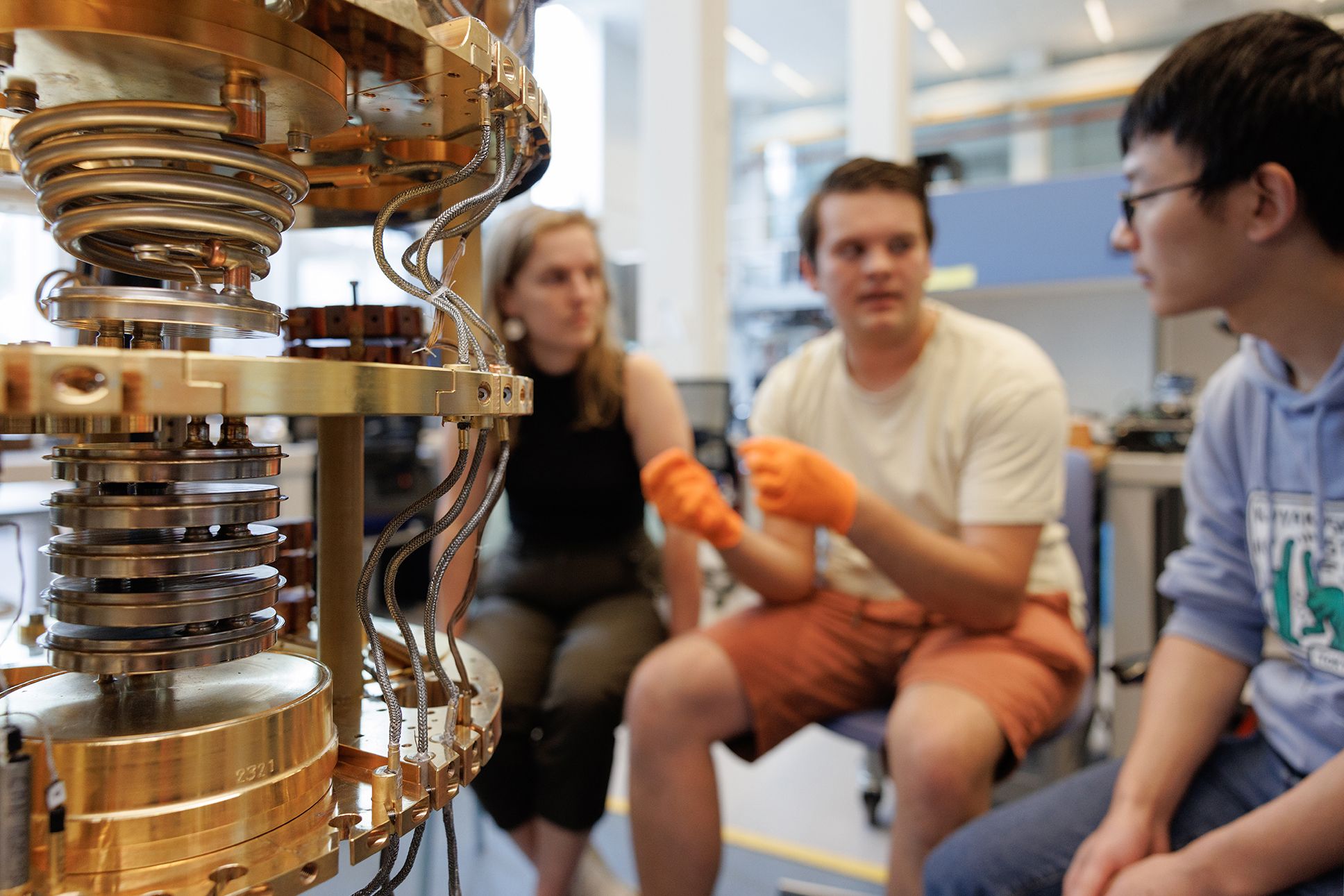
How do you ensure there are enough people in the quantum field with all the necessary levels of education? Jan Aarts, professor emeritus of physics at Leiden University, is working on this. “Quantum technology is revolutionary, so when it comes to talent development, don’t just think along traditional lines,” he advises.
By Maurice van Turnhout
How is the quantum sector working to achieve a balanced workforce? “As part of the QDNL growth fund program, Talent & Learning Centers (TLC) were established to raise the profile of ‘quantum’ in more applied educational programs as well. At the Quantum Hub Leiden, also part of the growth fund program, we reached out to the Leiden Instrument Makers’ School (LiS), a vocational program in precision engineering, which is located right next to us on campus.
“Together with TU Delft and The Hague University of Applied Sciences, we then founded the Leiden-Delft Talent & Learning Center (TLC, ed.). We all realized that the future of quantum technology cannot revolve solely around academics. Universities of applied sciences train outstanding technical professionals with a skill set that strongly complements our own, and vocational schools add additional hands-on skills to that.”
Could you give an example of a joint project? “At the LiS, they can create demonstration models and conduct experiments to help understand complex quantum mechanical concepts such as superposition. A commonly used visual aid is a mechanical sphere with an arrow inside it that performs a quantum operation. At the LiS, they’ve built a real-life version of this “sphere-with-arrow.” Students no longer need any background in physics or mathematics to grasp the concept of superposition. In projects like these, you see the complementary skillset in action. LiS students think in terms of practical technical requirements, and by consulting with a physicist or computer scientist, they are able to develop a product more quickly.
“The heart of the talent pipeline lies with the universities of applied sciences.”
“Because they’re best positioned to bridge the gap between both universities and vocational schools. And also because, in a sense, universities of applied sciences have a mandate to prepare students for the business world. The real problem is that the quantum industry is still in its infancy, making it difficult for universities of applied sciences to know what needs and requirements that industry will have.”
Do you hear those concerns from students who are potentially interested in a quantum program? “As far as I can tell, concerns about the future of their own profession are currently most prevalent among software developers and mathematicians, due to the rise of AI. This is much less of an issue for quantum computing. AI will never physically create a qubit in a laboratory—that will always be a job for humans.”
“Economic activity related to quantum technology is still modest, but it is growing. Next to our campus is the Bio Science Park, and through the growth fund, we were granted the use of a commercial building there, which now houses three quantum startups. These companies specialize in thermometry, quantum communication, and quantum sensing at low temperatures.”
“More generally, you notice that the alarming way in which AI is developing is contributing to growing societal skepticism and concern regarding new technologies. Quantum technology also presents the problem of dual-use—the fact that the technology can be used for both civilian and military purposes. But I believe quantum technology can bring us many benefits in the long run. It certainly offers a stimulating intellectual challenge—not only for academics but also for device developers. So it’s important to continue fostering a healthy curiosity about what we can do with this mysterious quantum technology.’
How do you go about fostering curiosity? “My colleague at Leiden, Evert van Nieuwenburg, develops quantum games, for example. For instance, he’s created a quantum version of the classic game of tic-tac-toe. Normally, you have to get three X’s or three O’s in a row. But quantum rules also allow you to put X’s and O’s in superposition, or to entangle them with each other. You can play a game like that with a ten-year-old without ever mentioning the word ‘quantum mechanics,’ but you’re definitely engaging in quantum mechanics. So that, too, is a way to make quantum mechanics more accessible and to spark talent.”
Do Dutch students have enough exposure to math and physics to get excited about quantum mechanics? “There are constant cuts to the number of math and science class hours in secondary education; that is indeed a cause for concern. Thanks to the growth fund, QLabs have been established at five locations in the Netherlands where students can conduct quantum experiments to learn about concepts such as the photoelectric effect. There is a fairly large QLab in Leiden that can accommodate about 600 students from the region each year. Nationwide, there should be many more, but it already takes a significant amount of money and manpower just to keep the existing ones running. The government could invest much more heavily in this area.”
“If you want Dutch schools to produce enough talent in the field of quantum science, you have to be willing to invest continuously. That funding doesn’t have to come solely through the traditional channels of the Ministry of Education. Developing talent for the tech industry has a very clear economic component.”
“Educational institutions should feel free to reach out to the Ministry of Economic Affairs”
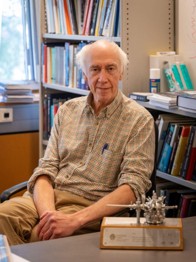 Jan Aarts is professor emeritus of Magnetic and Superconducting Materials at Leiden University. He leads the Quantum Hub Leiden, which is funded by the QDNL growth fund program. He is also the coordinator of QDNL’s Talent action line.
This is a preview of the new white paper “Quantum Talent” by Leiden-Delft-Erasmus Universities. The paper will be presented on December 10 at the Provinciehuis in The Hague. For more information, click this link.
Key Region Leiden promotes the application of Quantum Life Sciences (QLS) as a new field at the intersection of quantum technology, artificial intelligence (AI), and the life sciences. This combination has the potential to dramatically accelerate the development of personalized medicines and medical innovations. To effectively highlight these opportunities, we have drafted a white paper in collaboration with a number of partners. You can find it in this attachment: Quantum Life Sciences Key Region Leiden.
“Quantum is a stimulating challenge—and not just for academics”
25 November 2026
Tech Discovery Days at Unmanned Valley
5 October 2026



SME grant for feasibility studies on innovations.
4 March 2026
Els Frankhuijzen bridges the gap between strategy and execution
9 February 2026