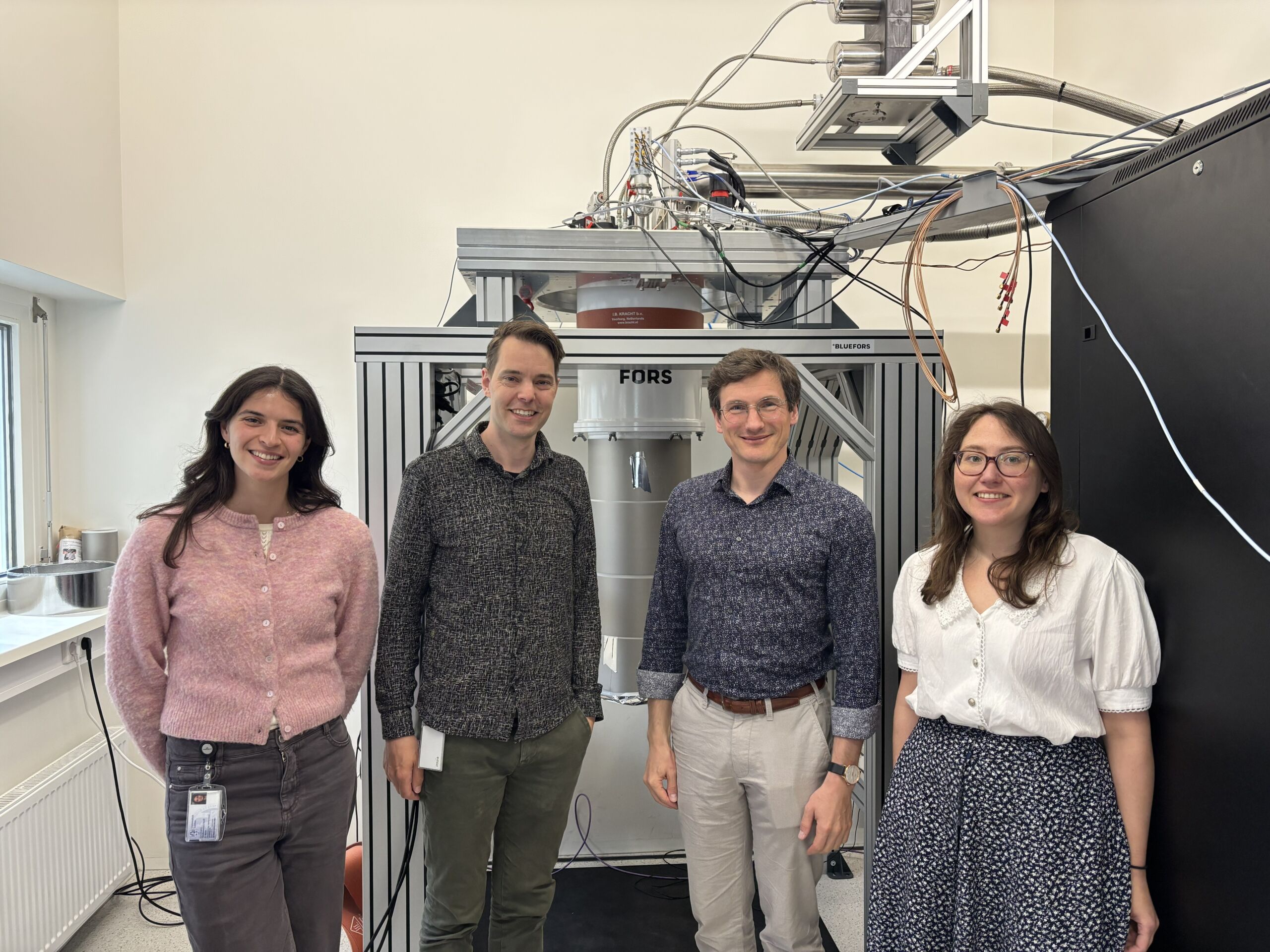
QuantaMap develops measurement instruments that allow quantum chip manufacturers to see what goes wrong in quantum chips at the nanoscale. This is essential to move quantum technology from the lab into industrial applications. We meet Johannes Jobst, CEO and founder of QuantaMap, at the House of Quantum in Leiden.
Why did you choose to start your company in this region?
“It wasn’t a strategic choice, but a logical one,” says Jobst. “We are a spin-off from Leiden University. The technology was developed here, so starting here made sense.” It has proven to be an excellent decision, as the BioPartner and HoQ quantum incubator provides the company with well-equipped, scalable workspaces and we have access to the nanofabrication cleanroom and engineering workshop at Leiden University. The location is also central and well connected within the region. “What makes this region unique is how compact everything is. Delft is just twenty minutes away, and many relevant stakeholders for us are based there. From my German perspective, that’s essentially one city.” This proximity enables fast collaboration and fosters an open culture. “You can easily reach out to people, which is essential when you want to innovate and scale quickly. Everyone is very open and eager to collaborate.”
What exactly do you do?
“Think of the classical semiconductor industry. During production, you continuously monitor what is happening. Without those checks, only about 40% of the chips would work. For quantum chips, those monitoring tools don’t yet exist.” The consequences are significant: “Sometimes only 10 to 20% of the chips function, even though they cost millions.” QuantaMap aims to change that. “We measure chip performance below 1 Kelvin. That’s –272 degrees Celsius, nearly absolute zero. We can see not only what a chip looks like but also how it behaves.” He proudly shows an image: “You can literally see electrical currents bending around defects. Our technology makes defects in quantum chips visible. That’s entirely new and urgently needed.”
Did you know?
- Quantum chips are tested at temperatures of around –272°C, some of the coldest conditions possible in the universe, just above absolute zero. It’s at these extreme temperatures that quantum effects become visible.
- This extreme cold also has a connection to Leiden: in 1908, physicist Heike Kamerlingh Onnes reached temperatures as low as –269°C there, laying the foundation for discoveries such as superconductivity. Leiden thus remains closely linked to some of the coldest experiments in the world.
What challenges did you face early on?
“Funding is always a factor, but technology even more so. Hardware can’t be rushed. A cryostat (a refrigerator capable of cooling down to 1 Kelvin) simply has a lead time of about six months. More money doesn’t change that.” There were also organizational challenges. “We had to make agreements on intellectual property (IP) with the university. That took longer than expected, because this type of spin-off is still relatively new here. Fortunately, we overcame that hurdle together with the tech transfer office.”
What does the network bring and what’s missing?
“The network is strong. Everyone helps each other, also in practical ways. For example, we work closely with QuantWare in Delft. We use their chips to better understand where performance is lost. That direct feedback accelerates the improvement of our technology and gives an edge in the global market.”
QuantaMap also collaborates with organizations like TNO in consortia. By combining knowledge and infrastructure, the transition from research to application is accelerated. Jobst also sees opportunities in stronger links with Leiden’s life sciences sector, where he believes there is still significant untapped potential. “Quantum can help simulate molecules and accelerate drug development.”
How do you stay agile as an entrepreneur?
“Through focus and making smart choices. We learned that in the Venture Academy program at PLNT Leiden. It was very valuable.” QuantaMap grew deliberately through subsidies and loans. “That allowed us to maintain control and flexibility. At the same time, you can’t do everything at once. You have to make choices and specialize. We focus on diagnostics. That’s our role, and we aim to excel at it.”
Where do you see opportunities for cross-sector collaboration?
“They’re more abundant than you might think. The technology is also being explored in space and defense. The underlying physics is the same, which makes further development into other applications a natural step. We should connect more often.”
And quantum life sciences in Leiden?
“That’s a huge opportunity. But someone needs to step up and truly build that bridge. That requires applications and integration. The sector is highly specialized – everyone focuses on one piece of the puzzle – but there’s still a missing party that brings everything together or develops real-world applications.”
[Side note: Key Region Leiden has published a white paper on the opportunities of quantum software for life sciences. You can read more here: https://www.keyregionleiden.nl/Projecten/quantumsoftware/]
What does your ideal work environment look like?
“Flexible and scalable. If we need an extra lab tomorrow, it should be possible. But ultimately, it’s about people. A strong team and a positive atmosphere make the difference.”
What advice would you give other entrepreneurs?
“Just start.” According to Jobst, the Netherlands provides a solid foundation: “There is capital, a network, and a willingness to help.” His key advice: “Talk to people who have already done it. It accelerates everything.”




SME grant for feasibility studies on innovations.
4 March 2026
Els Frankhuijzen bridges the gap between strategy and execution
9 February 2026
Leiden Bio Science Park core cluster in Wennink report
7 February 2026
Pioneers capital day April 8, 2026
6 February 2026
Innovation is the key to your growth
13 January 2026
The practical applications of autonomous tech
12 January 2026