
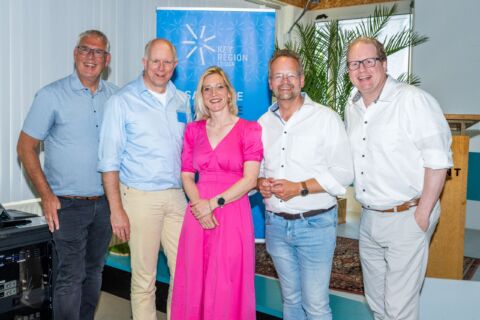
As of May 1, 2025, Key Region Leiden welcomes a new director: Leonie Hussaarts (pictured left). With her arrival, economic cooperation in the Leiden region will enter a new phase. Hussaarts succeeds Marielle Rillaerts (right in photo), who helped shape the renewed course from Publyon.
‘Building a leading innovation region together’
Leonie Hussaarts brings a solid dose of experience at the intersection of science, innovation and strategy. She received her PhD from LUMC and previously worked on complex collaborations at Lygature Foundation, QuTech and TU Delft’s Dream Hall, among others. “My heart is in innovation and building strong, knowledge-driven ecosystems. That I now get to do that in my own region makes me proud,” said Hussaarts, who lives in Leiden.
Three knowledge clusters
She says the potential of the Leiden region is enormous: “We have three powerful knowledge clusters here in the fields of biosciences, space and unmanned systems. The basis is strong and the cooperation between government, entrepreneurs and knowledge institutions is already impressive. In the coming years, we are going to further strengthen that connection and expand it into a leading international innovation region.’
Decisiveness
That ambition requires choices and decisiveness, she emphasizes. We are faced with important tasks concerning space, talent, innovation and the strengthening of SMEs. The coming period is therefore about building: on relationships, on projects such as the ROM-B and on a solid program organization. Only together can we make a difference, for the broad prosperity of our inhabitants and entrepreneurs.
Local economy
Over the past year, under the guidance of Marielle Rillaerts, the collaboration has made clear choices and set a clear course for the future. Central to this are the unique added value of the regional knowledge and innovation system and its potential for the earning power of tomorrow. The economic cooperation is fully committed to strengthening and connecting the knowledge clusters, as well as a stronger link with the local economy. This activity requires sustainable and future-proof business space. That is why we are investigating the establishment of a Spatial Development Company for Business Parks (ROM-B). We are also working more intensively with new partners. More information on this too will follow soon.

Thank you, aldermen!
14 July 2026
[Column] Who are you rooting for?
2 July 2026
Call to politicians: invest in broad prosperity
18 May 2026

Retrospective symposium on Broad Prosperity
11 March 2026

Extra boost for SMEs in Key Region Leiden
17 February 2026
WE ARE KEY: looking back on 8 months of cooperation
20 December 2025