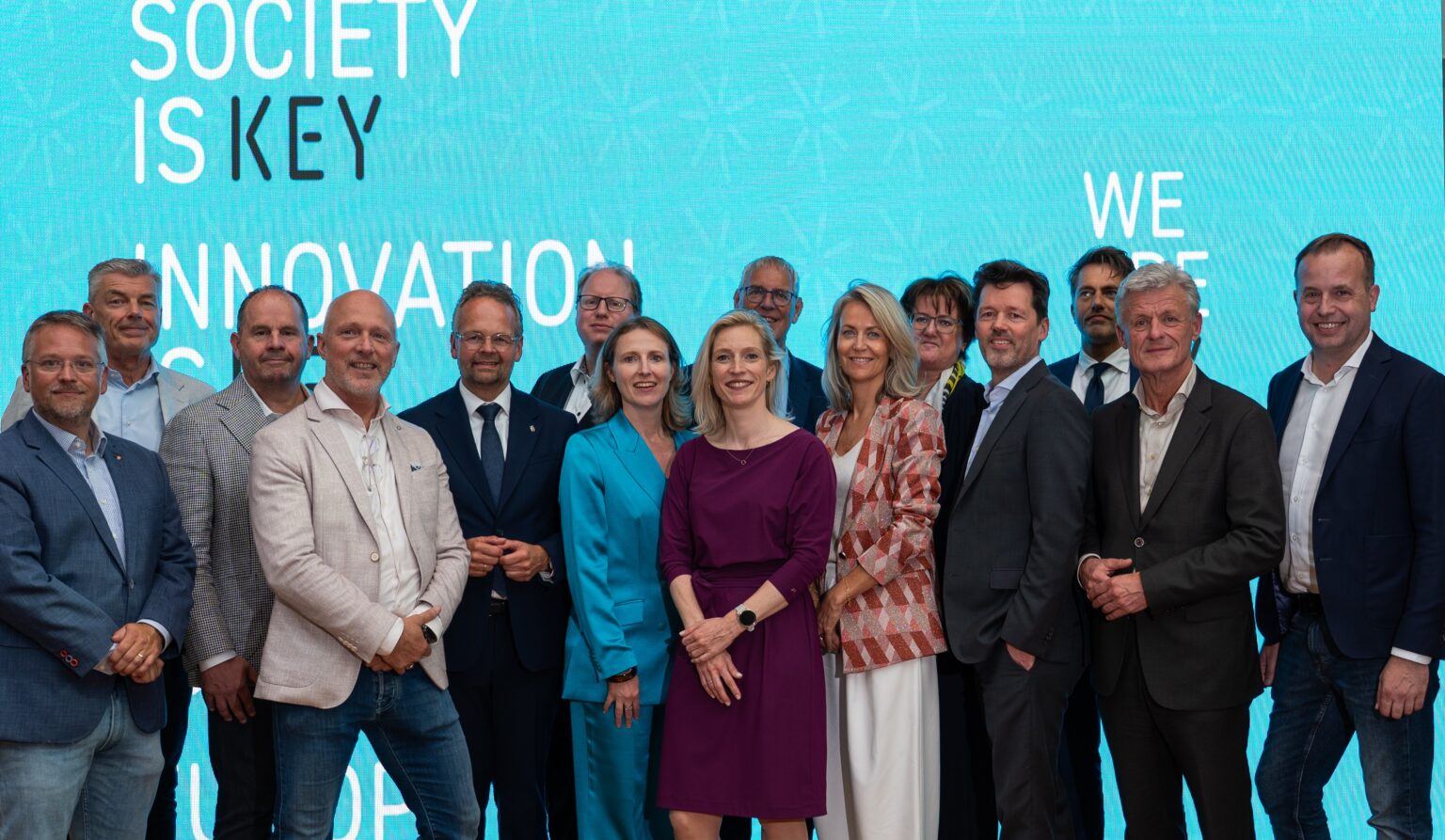
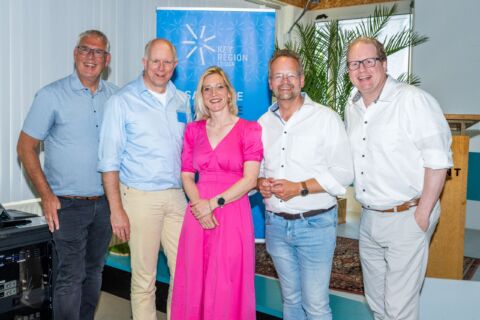
On July 7 at the Leiden Bio Science Park (LBSP), the renewed public-private partnership was launched for the Leiden-Katwijk-Noordwijk knowledge axis. Under the name Key Region Leiden, seven municipalities, three knowledge institutions, three entrepreneurial associations and three innovation clusters are joining forces to further strengthen the regional economy – built around 3 key sectors.

“With the LBSP, the NL Space Campus and Unmanned Valley, the region has gold in its hands,” said Wietske Veltman, Leiden alderman for economic affairs and chairman of Key Region Leiden “These three clusters are all unique in the Netherlands and of great importance for health, safety and European strategic autonomy. Together they form one innovation region that we are further strengthening with this public-private partnership. This is how we work on the economy of the future and the broad prosperity of tomorrow.”

From fundamental knowledge to application
Key Region Leiden brings science and application together. Within the 3 innovation clusters – bioscience, space and unmanned systems – 8 of the 10 key technologies are being worked on. From fundamental research at Leiden University and LUMC and technical ESA/ESTEC projects to high-tech companies converting this knowledge into groundbreaking innovations

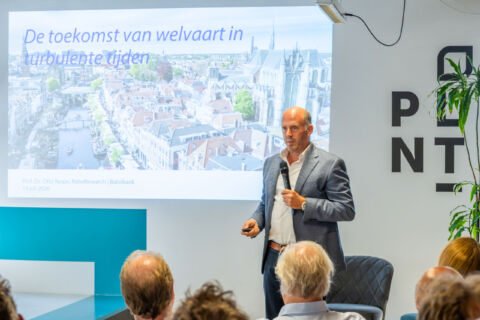
Those applications were highlighted in Plus Ultra by entrepreneurs and researchers from the innovation clusters;
- Meatable offers a solution to the climate impact of meat consumption with cultured meat.
- Soilspect uses satellite data to help construction projects run more efficiently.
- ANWB Medical Drones is working on a nationwide network of medical delivery drones.
- Huschka Security provides security for these knowledge-intensive businesses and links to the local economy.
- The practorate of mboRijnland and the lectorate of Hogeschool Leiden explained the value of practice-based research.

MBO Rijnland Board President Otto Jelsma talked about how the collaboration between research, education and business for training and retaining talent is being addressed. “By training together and binding talent to the region, we not only strengthen the innovation clusters, but also precisely the broad-based SMEs. That is crucial for a future-proof economy.”
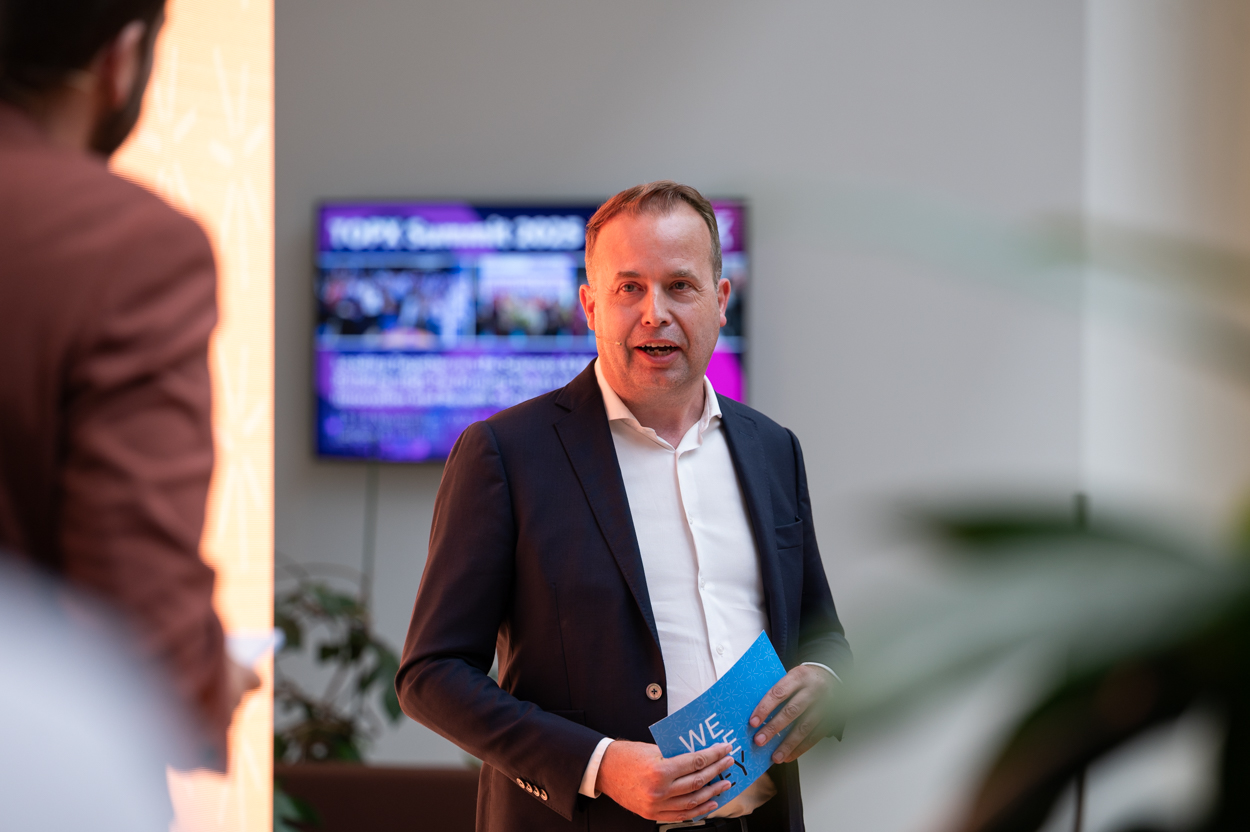
Leonie Hussaarts, Key Region Leiden director, summed up the afternoon nicely “Thanks to this collaboration, we can share knowledge much faster and smarter and engage in surprising crossovers. From quantum in drug development to shared use of cleanrooms. This is important for the Netherlands and Europe because it allows us to maintain our key position in these crucial areas. It is also important for all inhabitants of this region because thanks to this flourishing (knowledge) economy we can build broad prosperity together “
Three top clusters and eight of ten key technologies
Key Region Leiden focuses on three sectors important to Europe’s health, security and strategic autonomy:
Bioscience
With 519 organizations and more than 26,000 employees, the LBSP is the largest life sciences and health campus in the Netherlands and also the fastest growing campus in the Netherlands (Buck consultants 2024). This is where the therapies, drugs and vaccines of the future are being developed. For example, work is being done on organ models on a chip that make animal testing unnecessary and on vaccines that can be administered via a nasal spray.
Esther Peters, LBSP director: “The Leiden Bio Science Park is the largest life science & health cluster in the Netherlands. Bio science is number one of the 12 growth markets defined by the Ministry of Economic Affairs and life sciences as 1 of 10 key technologies is important for the growth of our national economy. If we want to maintain our leading position in Europe and continue to contribute to the future of health and technologies of tomorrow, we must invest today in infrastructure that supports our growth. We like to do this together with our strong region. In addition, Life sciences & health is increasingly driven by Data & AI. The cross-pollination in the region, with space technology and data and drones, accelerates the development of this knowledge and applications with tangible impact.”

Space
The NL Space Campus has grown around the technical heart of the European Space Agency; ESA / ESTEC. Here more than 125 companies come together and more than 4,000 people work. Not only precision components for satellites are developed but also space technology is used for solutions to societal issues such as flexible energy storage in iron ore.
Marc Sandelowsky, director NL Space Campus: “We see that momentum and attention to space technology and data has greatly increased as a result of the current geopolitical situation. The Netherlands can now cash in on its position as host country of ESA/ESTEC and fully support companies working with space technology. With this collaboration, the wider region now fully supports this “.
Unmanned systems
Unmanned Valley is the largest campus in the Netherlands in the field of unmanned systems. Here, systems are developed and tested for air, road and water. The drone sector in Europe is expected to at least double in the coming years.
Theo de Vries, director Unmanned Valley: “The demand for drones has increased exponentially, both for societal applications, such as crop inspection, and for security purposes. At Unmanned Valley, companies are given support and space to develop and test new models; for use in the air as well as on land and underwater.”
Within these clusters, 8 of the 10 key technologies from the National Technology Strategy are being worked on, including quantum technology, AI and data.
Leonie Hussaarts; “The Draghi report clearly shows that investing heavily in a strong innovation climate is vital for Europe. High-tech, space and medicine are explicitly named as crucial. By investing in innovation in these areas as a knowledge region, we contribute to this task and keep innovative entrepreneurs in the Netherlands. “.

Important for all activity in the region
Key Region Leiden is more than just high-tech and bioscience. The region is firmly committed to connecting with the local economy and on space for business.
“Key Region Leiden is a compact region where every square meter counts. In order to continue providing space for both the knowledge economy and the local economy, we must focus on compacting, making our business parks more sustainable and greening them. We want to do this through the development of a Spatial Development Company (ROM-B),” said Jacco Knape, alderman in Katwijk and administrative booster of the ROM-B.
We are also actively working on a Key Region Leiden pillar that connects the knowledge economy to the local economy.
Martijn van Pelt, board member at Key Region Leiden and chairman of VNO-NCW Rijnland: “Studies, such as from research firm Atlas, show that the knowledge economy is truly the engine of economic development in the region. However, those knowledge-intensive companies also need suppliers and their employees a vibrant hospitality industry and nice retail offerings. We are committed to all entrepreneurs in the region “.
Broad prosperity for all residents
The knowledge economy contributes enormously to the earning power of the region. This generates revenue that can be reinvested in amenities for all residents.
Wietske Veltman: “The LBSP has provided the municipality of Leiden with 56.9 mln over the period 2014-2022. That is more than 7 mln per year that we can invest in facilities for our residents. Strengthening the knowledge clusters thus contributes to maintaining the broad prosperity of the region.”
Otto Jelsma, MBO Rijnland board chairman: “What many people don’t know is that about 40% of the jobs at LBSP are filled at the MBO level. These are professionals with very special experience. Thanks to the cooperation with companies and governments within Key Region Leiden but also within specialized initiatives such as the Centra voor Innovatief Vakmanschap, we ensure that companies can find those professionals and that employees can gain interesting new knowledge.”

450 years of scientific tradition
In Key Region Leiden, science is brought to businesses to shape solutions to social problems. This fits with the scientific tradition in Leiden and the surrounding area; Leiden University was founded in 1575 as the first in the Netherlands and has largely shaped the pioneering mentality in the region.
Karin Horsman, director of strategy and academic affairs Leiden University “As a university, we place great importance on connecting with society and business. For example, thanks to all the companies at LBSP, we see that the fundamental knowledge we build up within the university and LUMC is transformed into therapies and medicines that directly make a difference in people’s lives. Strengthening this further is in keeping with our social mission”.
Building on 10 years of triple helix collaboration
Key Region Leiden is building on 10 years of triple helix cooperation within Key Region Leiden. The past year has seen an intensive development, with fundamental choices being made and new members joining. In addition to the three knowledge clusters, this includes the municipality of Noordwijk, which has become a partner specifically to strengthen the knowledge economy.
- Check out our Key Region Leiden Infographic.
[Column] How far into the future do you plan?
8 October 2026
Farewell to Councilwoman and Our Chairwoman Wietske Veltman
30 September 2026
Thank you, aldermen!
14 July 2026
[Column] Who are you rooting for?
2 July 2026
Call to politicians: invest in broad prosperity
18 May 2026

Retrospective symposium on Broad Prosperity
11 March 2026