

Strong in 8 out of 10
key technologies
Our bioscience, space andautonomous tech knowledge clusters are active in as many as 8 of the 10 key technologies. These technologies form the core of the National Technology Strategy and guide innovation policy, investments and cooperation between government, knowledge institutions and companies. On the scale of South Holland, the Netherlands and Europe.
Unique eco-system
Our eco-system has the highest knowledge density in the Netherlands in these eight key technologies. This offers enormous opportunities for crossovers, for startups and scale-ups. In Key Region Leiden they find the optimal conditions for establishment. This makes us a magnet for (international) talent.


Leiden Bio Science Park
Leiden Bio Science Park is the largest life sciences & health cluster in the Netherlands and ranks among the top in Europe. The park drives innovations that contribute to a healthier society.
Nearly 60,000 employees and students
More than 26,000 professionals work at the park and 27,000 students at all levels (from secondary and higher education to university) on the health of tomorrow. The park hosts 519 organizations, including 386 companies (including 92 start-ups), 133 research and educational institutions, and various social and cultural institutions.
Full supply chain in place
What makes the park special is the complete chain that comes together here – from basic research to large-scale production, from molecule to patient. All with a broad focus: from lifestyle and prevention to regenerative medicine, advanced therapies such as cell and gene therapy, and data-driven applications in MedTech and AI. Not for nothing does Leiden rank No. 1 in the Netherlands when it comes to biotech patents and drug production.

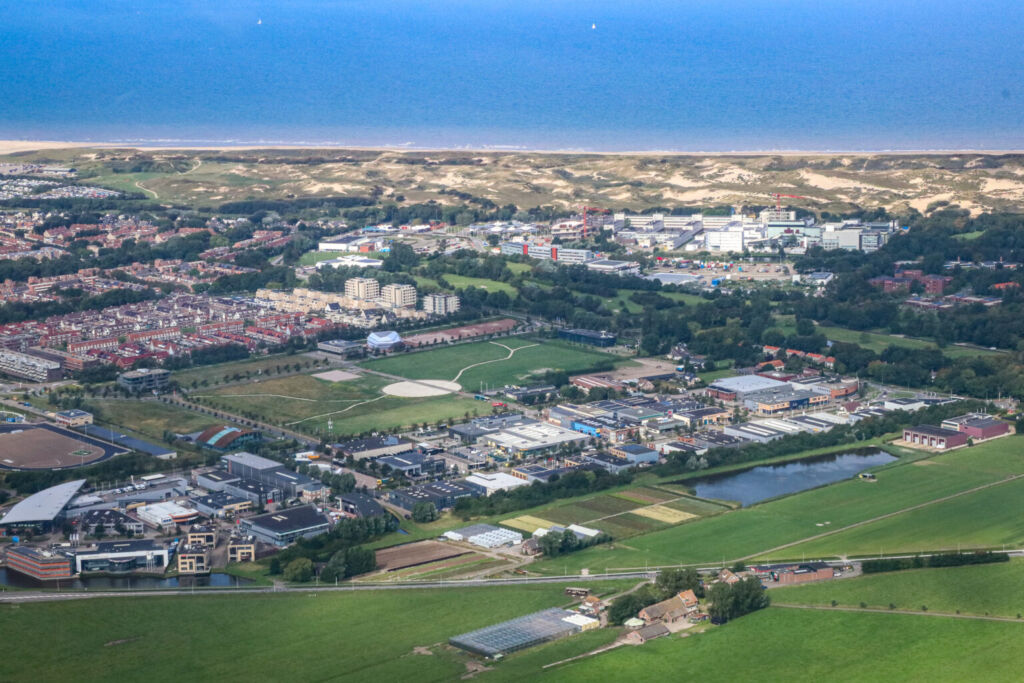
NL Space Campus
The Noordwijk campus is the beating heart of the Dutch space sector and plays a key role in space technology that also makes a difference on Earth.
Valuable Insights
On campus, companies, research institutions, and government agencies collaborate on groundbreaking technologies with applications that extend beyond space exploration alone. What changes are taking place in a polder? Where is a quay wall subsiding? How is air quality changing over a city? Satellites make it visible. Not only with “regular” images, but also with radar and measurements. This allows you to see patterns that you would miss with the naked eye.
The quality and frequency of satellite imagery have improved significantly in recent years. Thanks to a resolution of up to 30 centimeters per pixel and nearly monthly updates, new possibilities are constantly emerging. These include detecting changes in rural areas, measuring ground movement down to millimeters per year, and monitoring heat islands in cities.
In practice, you can see the effect of this right away. During high water, it quickly becomes clear which areas of land are flooded. And with special satellite measurements, you can identify differences in crops or soil quality that are barely visible from the ground. In short: satellites provide a wealth of valuable insights.
Unique facilities
In light of these developments and applications, the NL Space Campus offers unique facilities such as the CometLab, where students, startups, and companies can develop, test, and scale up concepts. In the Space Simulation Chamber, young developers can test their products in a simulated space environment.


Unmanned Valley
The campus in Katwijk is the national center forautonomous tech (drones), with 25 hectares of UAS test field and a 2,000 m² indoor test center. Here knowledge, demand and supply from the entire chain come together to create solutions for urgent challenges such as energy transition, personnel shortages, logistics, defense and agriculture.
Dual-use
Drones can be used to inspect tall buildings with solar panels on their roofs or to view the undersides of bridges (work that would otherwise usually have to be carried out from the water). In addition, drones are becoming increasingly important for our national security. Investments by the Department of Defense are driving rapid innovation. This is also accelerating the development of civilian applications (dual-use).

Netherlands largest innovation cluster for life sciences & health, among the top 5 in Europe. Here research, entrepreneurship and education in bio science come together for the future of health.

Hub of the Dutch space ecosystem. Provides accelerated innovation, economic growth and societal impact within the space sector. Connecting the curious.

Netherlands largest field lab for autonomous tech (drones) at former naval airbase Valkenburg. Here, high-tech applications are literally getting off the ground. Creating sensor-based impact.